- 17Custom warehouse apps running two mills
- 130,000+Lumber bundles tagged and tracked since 2023
- 230,000+Lumber movements recorded on the mill floor
The problem
Six months past the go-live date, with the warehouse still running the old way
NetSuite's own professional services team ran SmartLam's implementation. Six months after the planned date, SmartLam still couldn't go live. The finance setup was mostly there. The trouble was on the plant floor and in the yard, which is where SmartLam makes its money, and each new problem pushed the date back again.
- Lumber wouldn't fit the item list One board has a species, grade, width, thickness and length, and after grading it can come out Dry, Wet, Reject or Core. SmartLam buys lumber in thousand board feet and sells it by the linear foot. Every new combination was built by hand, and the costs didn't add up.
- The standard warehouse apps had no lumber processes NetSuite's apps are designed for picking boxes off shelves. Cutting and grading lumber, joining short pieces, reworking off-grade boards and gluing weren't there, so the team worked in spreadsheets.
- Tagging broke down at volume Tags got duplicated, used bundles showed up again, and a lost tag had no clean way back in. Bad tags meant bad counts and an inventory value nobody could stand behind.
What we did
Rebuild the items, then build the warehouse around lumber
Items that match how lumber is bought, made and sold
We rebuilt the item master around species, grade and dimension, so each lumber size follows a set pattern and nobody builds it by hand. That now covers 266 lumber items. Board feet, linear feet, weight and freight are worked out on every order line from factor tables SmartLam maintains, and an item without its factors can't be saved. Reject and Core lumber moves to a zero-cost copy of the original item, so off-grade boards no longer drag down the average cost of good stock.
17 warehouse apps for the way the floor works
We replaced the standard warehouse apps with apps built for SmartLam's shift supervisors. Each screen shows where every step stands, asks before doing anything that can't be undone, and makes sense without a training manual. The floor apps keep working when the mill Wi-Fi drops and send the work to NetSuite once the connection is back.
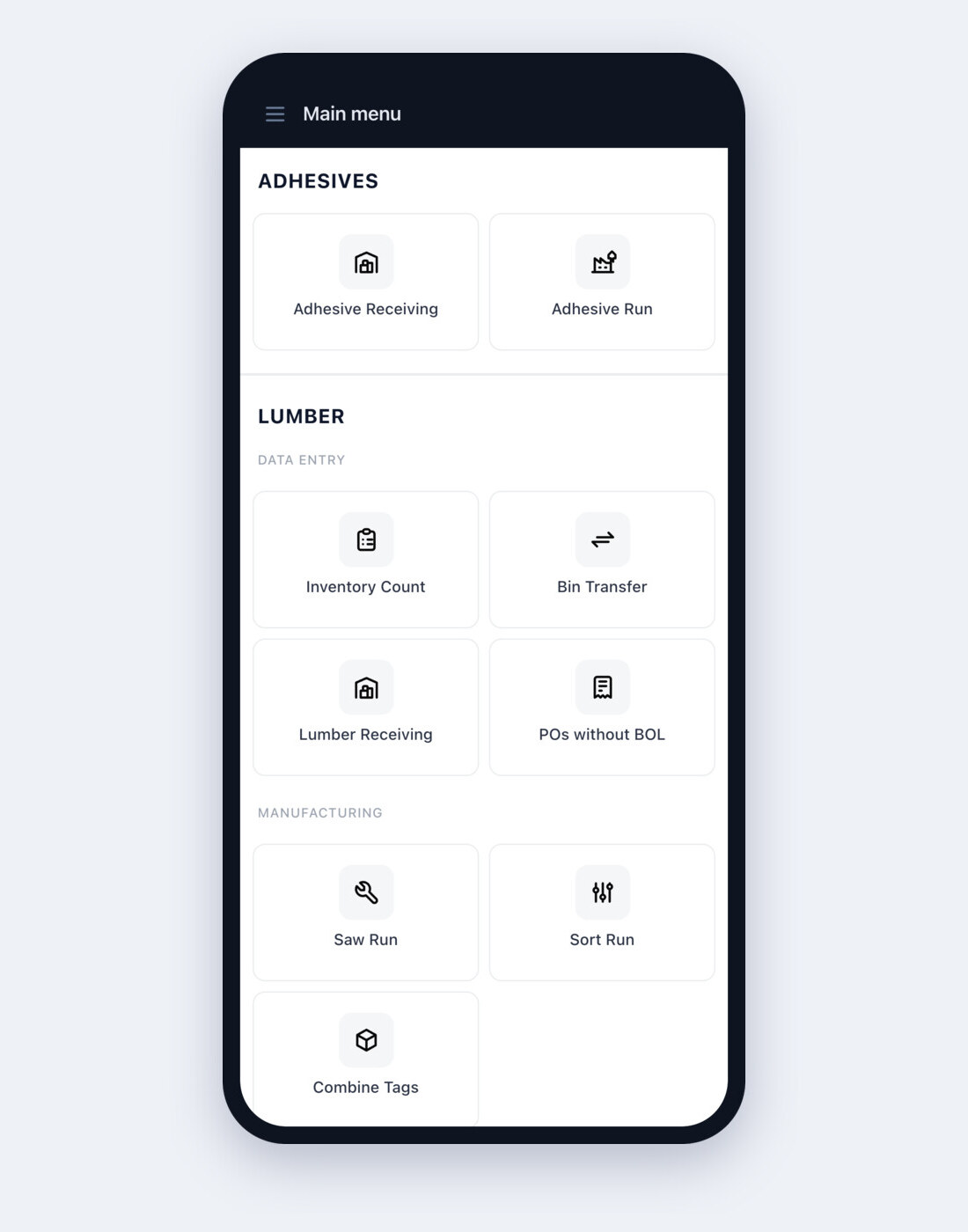
- Receiving Lumber is received against purchase orders in thousand board feet, with a cap on over-receipts and an email to the buyer when something looks wrong.
- Production Cutting, grading, joining, reworking and gluing each use up raw lumber or glue, record what came out and cost it.
- Moves and counts Bin, site and intercompany transfers, issuing lumber to production projects by scanning a tag, and cycle counts checked tag by tag.
- Tag control Each bundle gets one tag carrying its item, certification, length and status. Duplicates are stopped before they post, and a lost tag is restored through a controlled step that records who did it and why.
NetSuite and Zoho working from the same orders
SmartLam's sales and production teams work in Zoho, so we connected it to NetSuite and nobody types the same order twice. A new deal in Zoho becomes a project in NetSuite, creating the customer if needed. Commodity orders go from NetSuite to the production app at each mill, and when Zoho records a shipment, the matching NetSuite order is marked shipped. Any sync that fails is logged straight away, so it gets fixed the same week instead of at month end.
The results
A warehouse team that trusts the numbers
SmartLam went live, and it now runs both mills on NetSuite. Since 2023 more than 130,000 lumber bundles have been tagged, each one traceable to its item, bin and status, and the floor team has recorded over 230,000 lumber movements through the apps. Counts are checked tag by tag instead of reconciled in a spreadsheet.