
AI-assisted NetSuite implementation can make the work between a business decision and a tested system faster. It can organize requirements, propose data mappings, draft custom code and turn approved business scenarios into repeatable tests. It cannot decide whether the accounting design is right, whether migrated balances tie, or whether the company is ready to go live.
For a CFO or IT lead, the useful question is not how many AI agents a partner uses. It is what evidence the partner will put in front of you before each consequential decision. Oracle's implementation guide identifies data migration and user testing as major sources of delay and says the business still decides whether a customization is necessary.
Where AI helps
AI is most useful when it prepares work for someone who knows what the result should be.
| Implementation work | AI can help prepare | What proves the result |
|---|---|---|
| Requirements | Turn interviews and process notes into a list of decisions and contradictions | Process owner approves the requirement and an example transaction |
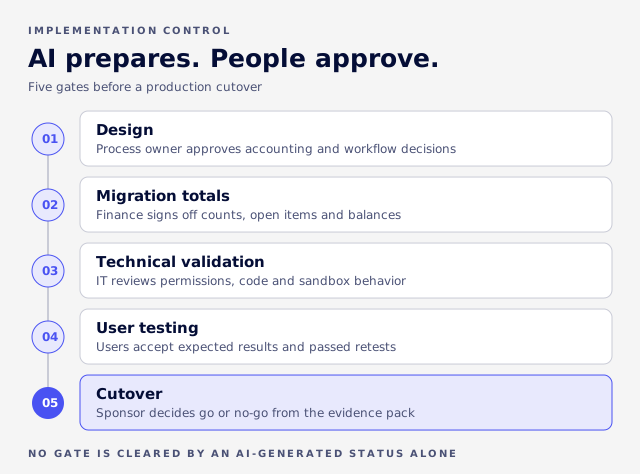
| Design | Compare documented options; draft a configuration or integration proposal | Finance approves the accounting effect; IT approves access and architecture |
| Migration | Profile duplicates, propose mappings, classify import errors | Record counts, open-item detail and balances reconcile to approved source data |
| Customization | Draft SuiteScript, SuiteCloud project files and documentation | Code review, account-aware validation and sandbox behavior tests |
| User testing | Draft tests from approved scenarios, collect results and summarize defects | Users confirm expected outcomes and sign off a passed retest |
| Cutover | Track dependencies and missing evidence | Named owners accept balances, open issues and the go/no-go decision |
The distinction matters most when the output looks convincing. A clean import log says the file was accepted; it does not say the opening A/R balance agrees with the legacy subledger. A passing automated test says observed behavior matched its expected result; it does not prove the expectation was right.
Start with a decision, not a prompt
Before an AI tool touches a requirement, name the business owner and the source it should use.
Suppose a company wants NetSuite to release vendor bills only after a second approver reviews invoices above a threshold. The starting point is an approved policy, examples of bills on either side of the threshold, and a decision about who can act as the second approver. AI can draft a process map, configuration options and test cases. It must not choose the threshold or approval authority because a meeting note was ambiguous.
This is also the point to ask whether native configuration is enough. Faster code generation does not make a customization necessary. Oracle's guide also notes that custom scripts and workflows add retesting work at each release.
For a troubled account, inventory the live configuration and the numbers before changing it. An AI-generated plan based only on handover documents can miss what is actually deployed.
Make the migration prove its totals
AI can find patterns in dirty data, but the migration acceptance test needs arithmetic and traceable records.
Consider an illustrative A/R migration. The source system has 1,240 open invoices and an approved A/R balance of $2.4 million at cutover. NetSuite accepts every import row, yet the target has 1,238 open invoices and $2.39 million in A/R. AI may help classify the two missing records and draft the exception report. Finance should not sign off until the count and amount differences are resolved or expressly accepted with a documented reason. The numbers here are synthetic, not a VCG client result.
For each material subledger, agree in advance on the cutoff, subsidiary, currency, accounting book, included transaction states and sign convention. Then retain both the source and target totals and trace a sample of individual records. Import status is one piece of evidence. Oracle documents CSV import validation and error reporting, but those checks cannot certify that a source balance was correct or that the migrated ledger ties.
When an existing build is being repaired, the same principle applies: decide what to fix or reimplement from the balances and system inventory, not from the speed with which an AI tool can generate a replacement.
Review generated customizations in the target account
Generated SuiteScript can be a useful first draft, but successful compilation is a narrow test.
Oracle's SuiteCloud Agent Skills give coding assistants task-specific guidance and reference material. Oracle still directs users to review generated output and test changes outside production. Its SuiteCloud Development Framework validation checks project structure, dependencies and required field values against the target NetSuite account. That can catch a broken project. It cannot decide whether the script posts to the right account or follows the approved process.
Ask for three separate checks before deployment: a technical review of code and permissions, a sandbox test of real business paths, and a finance check of the resulting transaction or report. If the customization changes a posting, the final check should include a ledger control total. If it handles approval, test both the allowed path and the attempted bypass. Our AI invoice capture guide shows how generated rules can pass every unit test and still never fire live.
Test what users actually do
An AI-written test is useful only after a process owner approves the expected result.
For a vendor-bill approval, test a bill below the threshold, one above it, an unavailable approver, a rejected bill and a user who should not approve their own submission. Record the account, role, test data, expected outcome, actual outcome and evidence. When a test fails, fix the cause and run it again; do not silently edit the expected result until it passes.
Oracle recommends a separate sandbox for business testing. A sandbox refresh replaces its previous state, so the test record should include the environment and refresh date. For upgrades, Release Preview is specifically intended to verify that existing business workflows still function on the new release. It is a separate exercise from accepting a new implementation.
VCG has used AI-assisted browser testing with screenshot and pass/fail reports across client accounts. A person still runs and watches those tests. What matters to a controller is the evidence they leave behind, not the tooling that produced it.
Put IT and finance at the same gate
Finance owns the numbers and process outcome; IT owns the tool and access path.
Before using an external AI assistant with NetSuite, IT should approve the client, its data handling, the user role, the tools it can invoke, the treatment of write actions and how access is revoked. Finance should approve the questions the assistant may answer and the checks required before an answer becomes a decision. Oracle says MCP tools run under the user's role, log their use, and cannot run as Administrator. Oracle also warns that NetSuite cannot control how an external client handles data after authorized access.
The same discipline applies to coding assistants even when they do not connect to NetSuite. Client data, credentials and production deployment authority should not become a convenient input to a prompt. Review what the tool can read and change before the implementation team begins.
Decide go-live from evidence
The go-live question is whether the business can operate and close on the new system, not whether the project board is green.
A useful go/no-go pack contains approved design decisions, migrated balances and open-item tie-outs, unresolved exceptions with owners, security and integration checks, user-test results, training readiness and a contingency plan. AI can assemble the pack and highlight missing items. The controller and IT owner must resolve or accept the exceptions, and the accountable sponsor makes the cutover decision.
After go-live, compare the first close and key process outcomes with the baseline set before implementation. If a vendor promises that AI will cut weeks from the project, ask which task was shortened, how review time was counted, and whether any defects moved into hypercare.
Questions to ask an implementation partner
These questions make an AI-assisted proposal easier to judge:
- Which deliverables will AI draft, and who approves each one?
- What source data and reports establish the migration control totals?
- How are generated code and permissions reviewed in the target account?
- Who approves test expectations, and what evidence is retained for failures and retests?
- Which AI tools can access client data or production NetSuite, and how can access be revoked?
- What unresolved differences would stop go-live?
A partner should be able to answer with artifacts and named decision owners. VCG's system integration and SuiteScript automation work sits inside that broader implementation discipline. If your project is stuck because the data, tests or configuration no longer agree, Book an Assessment.