
The short answer
From NetSuite 2027.1 you can't create new TBA integrations, existing ones lose support tentatively in 2028.2, and SOAP is removed in 2028.2.
2027.1 is the next release after 2026.2, and Oracle gives no calendar date for it. That makes NLAuth the urgent item, because apart from existing IssueToken calls, anything signing in with it stops working at that release. Nothing we found from SuiteWorld 2026 changes these dates, as our SuiteWorld overview explains.
Your first step costs little and needs no developer: pull the Manage Integrations and Access Tokens lists, and put an owner against each line. NLAuth callers hold no token, so also search your integration code and ask vendors whether anything sends an NLAuth header. Start that this week.
The NetSuite TBA deprecation and the move to OAuth 2.0 are linked to the SOAP removal, but each has its own date (Oracle: Preparing for TBA End of Support). Token-based authentication (TBA) is a long-lived set of four credentials an outside system uses to sign in to NetSuite. OAuth 2.0 replaces them with short-lived access passes, but it can't be used with SOAP web services, NetSuite's older integration interface.
The other two interfaces named in the table are REST web services, the current interface, and RESTlets, custom NetSuite scripts that outside systems can call.
| Release | What changes | Who is affected | Oracle's wording |
|---|---|---|---|
| 2027.1 | No new TBA integrations | Anyone building for SOAP, REST web services or RESTlets | Firm |
| 2027.1 | NLAuth integrations stop working | Anything signing in with NLAuth, the older method that sends login details, except existing IssueToken calls | Firm |
| 2027.1 | PKCE required on new authorization code integrations | New OAuth 2.0 builds | Firm |
| 2027.1 | Require 2FA for All Roles turned on automatically | Every account; covers Employee, Vendor and Partner roles; administrators can disable it | Firm |
| 2028.2 | TBA support ends for existing integrations | SOAP, REST and RESTlet callers | "Tentatively" |
| 2028.2 | SOAP removed, all endpoints disabled | Every SOAP integration | No qualifier |
The 2027.1 rows come from Oracle's release notes (Oracle: 2026.1 Authentication Release Notes), and the SOAP row from its versioning page (Oracle: SOAP Web Services Versioning).
This is correct as of November 2026, so recheck Oracle's page before you set final dates. "Tentatively" could change, and Oracle isn't consistent about it. Its overview page says support ends in 2028.2 without the qualifier (Oracle: Token-based Authentication (TBA)).
One row hits every account. Require 2FA for All Roles turns on automatically in 2027.1, and Oracle doesn't explain how it affects client credentials or existing IssueToken callers. Test both in Release Preview before that release: from outside NetSuite, with the integration's real role, get a token and make one read and one write. It passes when the job runs unattended with no 2FA prompt.
Do existing integrations stop in 2027.1?
TBA integrations keep running past 2027.1, but NLAuth integrations stop at that release.
Oracle says existing TBA integrations "will continue to work until the final end of support of the TBA feature". For NLAuth, "all integrations that use NLAuth as an authentication method will stop working" as of 2027.1, which makes it the earliest hard break in the whole change (Oracle: 2026.1 Authentication Release Notes).
The IssueToken endpoint, an older way to obtain a TBA token, looks like an exception worth checking because it uses an NLAuth header. The same notes settle it: the NLAuth end of support "doesn't include the existing integrations that use the IssueToken endpoint". New integrations can't use IssueToken or the three-step TBA flow from 2027.1.
Three planning points follow:
- Anything going live after 2027.1 should be built on OAuth 2.0 now, including a replacement for an existing connection.
- Plan to 2028.2 for TBA anyway. A tentative date can move either way, and the longest jobs need the time.
- Oracle says existing SOAP integration records may still be updated, but doesn't say whether a new token can be issued on an existing TBA record after 2027.1. Treat that as an open question and don't plan around it (Oracle: SOAP Removal Plans FAQ).
How to find what uses TBA
Start from the records in the account, because the forgotten callers are rarely the ones teams name first.
Look hard at read-only reporting extracts, nightly backup jobs, cloud functions calling RESTlets, ad hoc scripts and developer tools, as well as the integration platform flows people mention. This is the same discipline as any NetSuite rescue inventory: read the account before you believe the list.
- List integration records under Manage Integrations.
- List access tokens under Access Tokens, and note the application, user and role on each. Oracle also offers a search page for tokens (Oracle: Using the TBA Access Token Search Page).
- Check activity in the Login Audit Trail. Check Use Advanced Search, then add Detail, Token-based Application Name and Token-based Access Token Name as results (Oracle: Advanced Login Audit Trail Search).
- Put a business owner against every token. If you can't name one, that token goes to the top of the list.
Run the audit search across a period that includes a month-end, since a monthly job won't show in a one-week window. Oracle doesn't document a last-used date on tokens or how long the audit trail is kept, so confirm both in your account.
NLAuth callers hold no token, so the token list won't show them. Search integration code for an NLAuth header and ask vendors directly. A login under a service user with no token application name is a lead to follow, though not proof.
Two traps during the inventory
One credential set may serve several callers, so turning off a token can break more than the one system you had in mind.
A cloud function calling a RESTlet is a hidden dependency. A corporate single sign-on token is not a NetSuite credential, so something in that function holds a TBA or NLAuth login you need to find.
One-page worksheet
The rows below are invented examples.
| Caller | Owner | Method | Vendor or custom | Process | Last seen | Route | Date |
|---|---|---|---|---|---|---|---|
| Nightly sales extract | Controller | RESTlet + TBA | Custom | Revenue report | Yesterday | Change credentials | Before 2028.2 |
| Bank payment file | AP lead | SOAP + TBA | Custom | Vendor payments | Friday | Rebuild | Before 2028.2 |
| Old cloud function | Unknown | NLAuth | Custom | Unclear | Last month-end | Replace | Before 2027.1 |
| BI tool | Finance systems | Connect + TBA | Vendor | Board pack | Today | No forced action | None announced |
Sort callers into four routes
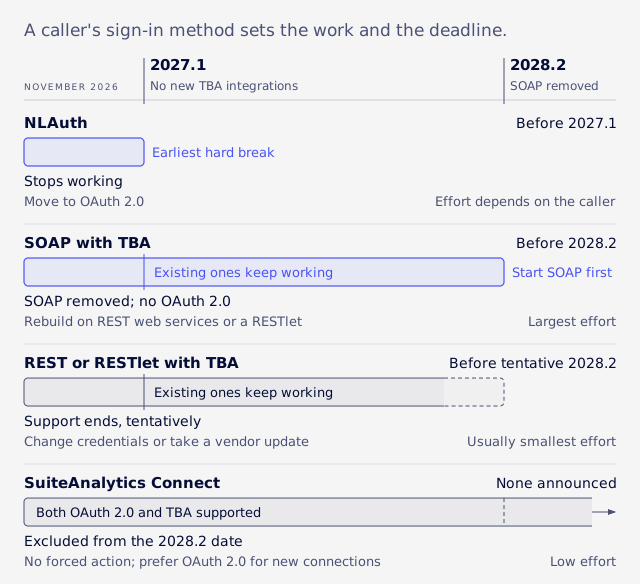
Each caller takes one of four routes, and its sign-in method sets the work and the deadline.
| Method | What Oracle says | What you do | Relative effort | Deadline |
|---|---|---|---|---|
| NLAuth | Stops working | Move to OAuth 2.0 | Depends on the caller | Before 2027.1 |
| SOAP with TBA | SOAP removed; no OAuth 2.0 | Rebuild on REST web services or a RESTlet | Largest | Before 2028.2 |
| REST or RESTlet with TBA | Support ends, tentatively | Change credentials or take a vendor update | Usually smallest | Before tentative 2028.2 |
| SuiteAnalytics Connect | Excluded from the 2028.2 date | No forced action; prefer OAuth 2.0 for new connections | Low | None announced |
The effort column is relative sizing and assumes the caller's code or vendor can still be reached. An integration with no source code and no owner will take more work than its row suggests.
Does OAuth 2.0 work with SOAP?
No, so every SOAP integration needs a rebuild on REST web services or RESTlets before 2028.2.
Oracle's two statements are "OAuth 2.0 can't be used with SOAP web services" and "existing SOAP integrations with NetSuite will stop working" with the 2028.2 release. The rewrite is VCG's reading of those two, and Oracle advises planning a move to REST "as soon as possible" (Oracle: OAuth 2.0 for REST Web Services, Oracle: SOAP Web Services Versioning).
The SOAP timeline has one conflict you should know about:
- 2027.1: no new SOAP integrations. Existing ones keep working, and their records may still be modified.
- 2027.1 or 2027.2: only the last endpoint is supported. Oracle's versioning page says 2027.1 and its FAQ says 2027.2, so plan to the earlier one (Oracle: SOAP Removal Plans FAQ).
- Last endpoint: 2025.2 is the last planned one, though later ones may be released if needed.
- 2028.2: all endpoints disabled.
Check what REST can do before assuming a gap. Oracle lists File and Folder as supported in REST (Oracle: SOAP and REST Supported Records). REST can run a saved search, but it can't create or edit one or override its criteria (Oracle: Using Saved Search in REST Web Services).
A RESTlet runs SuiteScript, so it can handle what REST won't. Oracle's upgrade guide compares the operations side by side (Oracle: SOAP Web Services to REST Web Services Upgrade Guide).
Start SOAP first, because it's the one route that needs new code and new testing and not only new credentials.
What about SuiteAnalytics Connect?
Oracle excludes SuiteAnalytics Connect (ODBC/JDBC), the database-style link BI tools use, from the 2028.2 end date and supports both OAuth 2.0 and TBA on it.
Oracle says both can be used together and calls OAuth 2.0 preferred (Oracle: OAuth 2.0 for SuiteAnalytics Connect, Oracle: Requirements for Using OAuth 2.0 for Connect). The pages give no end date for TBA on Connect. That is different from saying it will never end.
Don't rush to create spare tokens. Oracle's 2027.1 restriction names SOAP, REST and RESTlets, not Connect, so stockpiling solves a problem Oracle hasn't described.
One Oracle page says OAuth 2.0 is "only available for REST web services and RESTlets", which conflicts with the dedicated Connect pages. Follow the Connect pages, and test a connection in sandbox. If Connect feeds a warehouse, the NetSuite to Snowflake guide covers that route.
Which vendors are ready?
Oracle's pages don't confirm which vendors support OAuth 2.0 yet, so ask each one in writing.
Oracle says connectors "may require an updated configuration, or a connector version update", and gives Boomi, Celigo, MuleSoft and Informatica as examples, without saying which have shipped OAuth 2.0 support.
Send the same five questions to every vendor, including Workato, bank, tax, EDI and BI tools:
- Does your NetSuite connection support OAuth 2.0 today?
- Which flow, client credentials or authorization code?
- Which version, and is the upgrade charged?
- Do you handle certificate rotation, or do we?
- What is your date, in writing?
If a vendor can't answer, escalate early and set your own decision date. Price a replacement or a custom integration route as the fallback, so a late answer doesn't leave you without options.
Who owns what
Four owners cover the work, and the rotation calendar should sit with one named person.
| Owner | Responsible for |
|---|---|
| Controller or CFO | Business list and risk decisions |
| NetSuite administrator | Tokens, roles and certificates |
| Vendor or developer | The change itself |
| One named person | The rotation calendar |
Ask which close steps depend on each caller, so the risk has a name and a date on it.
The order of work
Take the inventory first, because every later step depends on knowing what actually calls NetSuite.
- This month, take the token inventory and assign owners.
- Find NLAuth callers, since they have the earliest deadline.
- Rule that nothing new is built on TBA, since new TBA integrations end at 2027.1.
- Send the vendor questions and record the answers.
- Scope SOAP rebuilds first, because they take longest.
- Cut over REST and RESTlet integrations one at a time, lowest risk first.
- Set up the certificate calendar and alerts.
- Revoke old tokens after a clean month-end.
Controllers and CFOs can stop here and forward the rest, which covers flows, tokens, certificates and the cutover.
Which flow suits a nightly job?
Use client credentials for unattended jobs, and keep authorization code for integrations that must act as a specific person.
That is advice, not an Oracle rule. Client credentials is machine to machine: the system signs in with a certificate. With authorization code, a person signs in through a browser and authorizes the app.
Oracle describes NetSuite refresh tokens as one-time use for public clients, so two workers sharing one refresh token can break each other. Choose the service identity before the design: a certificate maps to one integration record, role and entity, so use a dedicated service entity and not an employee who may leave.
New authorization code integrations also need PKCE from 2027.1. PKCE is a check that stops an intercepted sign-in code being reused. S256 is the only accepted method, and existing integrations without it keep working (Oracle: Authorization Endpoint).
How long tokens last
An access token lasts 60 minutes, so an unattended job must fetch new ones itself and alert someone when it can't.
Oracle says expires_in is always 3600 (Oracle: POST Request to the Token Endpoint). What happens next depends on the flow:
- Client credentials: Oracle's documented response has no refresh token, so the system sends a new signed request.
- Authorization code: a refresh token gets a new access token. For public clients, Oracle says it lasts two days by default, is one-time use, and can be set from 1 to 720 hours on the integration record. The page doesn't state a lifetime for confidential clients, so test yours (Oracle: Refresh Token POST Request).
An expired refresh token returns invalid_grant and sends the flow back to its first step, where a person signs in again. For finance, the first symptom may be a stale report or a missing payment file, so add an alert on authentication failures.
A sensible retry rule is that a 401 on an expired access token gets one refresh and retry, while a 403 or a validation error is final. A 401 can also mean a bad signature or timestamp, so check those before you assume the credential is dead. Don't let an integration retry-loop against a rejected credential, because it can lock or throttle access.
Creating and rotating certificates
Create one certificate for each integration, role and entity, and replace it before its two-year maximum validity ends.
Oracle's requirements:
- Key: RSA 3072 or 4096 bit, or EC 256, 384 or 521 bit, in x.509 format.
- Validity: two years at most, and NetSuite shortens anything longer (Oracle: Client Credentials Setup Conditions).
- Signing: PS256, PS384, PS512, ES256, ES384 or ES512. RS256 isn't on Oracle's list, so don't copy an example that uses it (Oracle: The Request Token Structure).
One certificate serves one combination of integration record, role and entity. A certificate can be issued for less than two years, and a revocation or key compromise forces earlier replacement, so rotation is a recurring calendar task with a named owner.
- Log each certificate's expiry on a calendar a team owns.
- Upload the new certificate and map it to the integration record, role and entity.
- Switch the integration to the new key and Certificate ID.
- Test it, including a write.
- Revoke the old certificate.
Oracle also documents an endpoint to list, add and revoke certificates, which needs the Manage own OAuth 2.0 Client Credentials Certificates permission (Oracle: OAuth 2.0 Client Credentials Certificate Rotation Endpoint).
Never log a signed token, even at debug level, and move any key hardcoded in a script into a proper secret store before rotating.
Don't confuse any of this with the 90-day rotation in Oracle's documents. Those certificates validate tokens in the authorization code flow, and NetSuite generates new ones itself (Oracle: OAuth 2.0 Token Structure and Certificate Rotation).
Roles, permissions and 2FA
Revalidate the integration's role on every move, because working in the UI doesn't prove a machine role has what it needs.
2FA is two-factor authentication, a second sign-in check. Check for REST web services and SuiteQL permissions specifically. SuiteQL is NetSuite's SQL-style query language. Keep to least privilege, with one role per integration where practical. The NetSuite role permissions guide explains Log in using Access Tokens versus Log in using OAuth 2.0 Access Tokens.
Keep setup and access apart. OAuth 2.0 Authorized Applications Management requires 2FA and is meant mainly for administrators. It doesn't let a role call the APIs, which takes Log in using OAuth 2.0 Access Tokens (Oracle: Set Up OAuth 2.0 Roles). Scopes are restlets, rest_webservices and suite_analytics, so grant only what the integration needs (Oracle: The Request Token Structure).
Sandboxes and the cutover
Switch one integration at a time, keep the old token as your rollback, and revoke it only after a clean month-end.
Sandbox first, and test it alongside any NetSuite Next rollout work. Oracle says OAuth 2.0 authorized applications aren't copied from production and must be authorized again after each sandbox refresh (Oracle: OAuth 2.0 for REST Web Services). That page covers authorized applications, so check in your own sandbox whether a client credentials setup and its certificate mapping survive a refresh, and add the result to your refresh checklist.
Oracle doesn't confirm whether one integration record can run both methods, and this plan doesn't need it:
- Create a new OAuth 2.0 integration record for each integration. Save the client ID and secret straight away, because Oracle shows them only the first time you save the record (Oracle: Create Integration Records for Applications to Use OAuth 2.0).
- Check that NetSuite-side RESTlets and scheduled jobs can safely run twice. Integration platforms retry on their own, so a failed first run can duplicate records.
- Check timeouts, since a slower token fetch can push a borderline flow over its limit.
- Test end to end, including a write. A successful token fetch proves little, and permission mistakes show up later looking like broken authentication.
- Run a full cycle, including month-end jobs.
- Retire the old token. Revoking is permanent and the Inactive box can be undone, so set it Inactive first and revoke once the next cycle stays clean. Deleting the old application record revokes all its tokens, so leave that until last (Oracle: Viewing, Editing, Creating, and Revoking TBA Tokens).
FAQ
Short answers to the questions that come up once the inventory starts.
Can we wait until 2028.2 becomes firm?
You can wait on the REST and RESTlet work for a while, but not on NLAuth, SOAP scoping or the rule against new TBA builds.
Do we need a developer?
Not for the inventory or the vendor questions. Custom callers and SOAP rebuilds will need one.
Where to get help
Where the inventory turns up tokens with no owner or integrations no one can explain, a second pair of eyes is worth having.
VCG's NetSuite rescue work starts by reviewing what actually runs in an account before anything changes. If that is where you are, Book an Assessment.